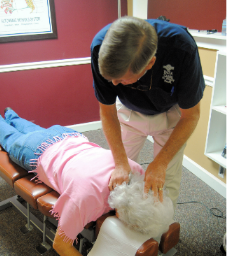
Spinal decompression angles change because each disc sits at a different position within the spine and responds to force differently. Adjusting the patient’s position and line of pull helps direct decompression toward the lumbar or cervical level connected to the patient’s symptoms.
This is one reason spinal decompression therapy is not simply a matter of applying traction to the entire spine. The location of the affected disc, the direction of symptoms, the patient’s anatomy, and the treatment goal all influence how the therapy is performed.
For patients in Wheat Ridge, CO, understanding these differences can make the treatment process feel less mechanical and easier to follow.
What Does a Decompression Angle Mean?
A decompression angle refers to the direction in which a controlled pulling force is applied to the spine. The table position, harness placement, body posture, and amount of flexion can change which spinal region receives more of that force.
The spine is curved rather than completely straight. Its discs are also positioned between differently shaped vertebrae.
Because of this structure, one fixed angle would not place equal emphasis on every disc. A position intended to reach a lower lumbar level may not be appropriate for an upper lumbar disc. Cervical decompression requires a different setup because the neck is smaller, more mobile, and positioned differently from the lower back.
The goal is not to pull as hard as possible. It is to apply a controlled force in a direction that matches the area being addressed.
Why Do Lumbar Disc Levels Require Different Positions?
The lumbar spine contains five vertebrae, commonly identified as L1 through L5. The discs between these vertebrae carry substantial loads during sitting, standing, bending, lifting, and walking.
Lower lumbar levels, especially those near L4-L5 and L5-S1, often experience different mechanical demands than the upper lumbar region. The angle of the pelvis and the natural curve of the lower back affect how traction reaches these areas.
During lumbar decompression, changing the table angle or the amount of hip flexion may shift the emphasis toward a particular section of the lower back. A flatter position may distribute force differently than a position in which the hips and knees are slightly bent.
The patient’s comfort also matters. A position that reduces symptoms for one person may increase irritation for another, even when imaging shows a similar disc level.
This is why lumbar decompression should be adjusted according to examination findings and treatment response rather than delivered through one standard setting.
How Is Cervical Decompression Different?
Cervical decompression focuses on the seven vertebrae of the neck. These joints support the head while allowing rotation, bending, and extension.
The cervical spine has a different curve and much smaller structures than the lumbar region. It also contains nerve roots that may contribute to pain, numbness, tingling, or weakness traveling into the shoulder, arm, or hand.
During cervical decompression, the position of the head and neck affects which levels receive more emphasis. Small changes in neck flexion can alter the direction of the pulling force.
A patient with symptoms connected to a lower cervical disc may require a different setup from someone whose discomfort appears to involve an upper level. The amount of force is also typically much lower than what may be used during back decompression.
Careful positioning is important because excessive extension, rotation, or pulling force may aggravate an already sensitive area.
Does the Pain Location Reveal the Affected Disc?
Pain location provides useful information, but it does not identify the disc level by itself.
A lower lumbar disc problem may cause centralized back pain, discomfort into the buttock, or symptoms traveling down the leg. However, muscles, joints, and other tissues can create similar patterns.
Cervical disc irritation may contribute to neck pain or symptoms in the shoulder and arm. Yet shoulder conditions and peripheral nerve problems can sometimes feel similar.
Before spinal decompression therapy begins, the provider may review the patient’s history, movement patterns, strength, reflexes, sensation, and available imaging. These findings help determine whether the suspected disc level matches the overall symptom pattern.
Treatment should address the patient rather than an imaging report alone.
Why Is More Pulling Force Not Always Better?
A stronger pulling force does not automatically create a better result.
Too much force may cause the body to tighten defensively. It may also increase discomfort or cause symptoms to travel farther into an arm or leg.
Spinal decompression is generally introduced at a tolerable level and adjusted according to the patient’s response. The provider may change the angle, treatment time, force, or body position over the course of care.
A useful response may include reduced symptom intensity, improved movement tolerance, or symptoms moving away from the extremities and closer to the spine. Increased numbness, weakness, or radiating pain may indicate that the treatment plan needs to be reassessed.
The right setting is the one that remains safe, controlled, and appropriate for the patient’s condition.
Can the Angle Change Between Appointments?
Yes. Decompression settings do not necessarily remain the same throughout an entire treatment plan.
Symptoms can change as irritation decreases or movement improves. A position that was comfortable during the first appointment may no longer be the most useful setting several visits later.
Providers may also learn more from the patient’s response. If one angle reduces leg symptoms while another aggravates them, that information can help guide later sessions.
Changes in decompression settings do not always mean the original approach was incorrect. They may reflect the need to adapt treatment as the patient’s condition changes.
What Should Patients Expect Before Decompression Begins?
Before receiving back or neck decompression, patients should expect an evaluation that goes beyond identifying where they hurt.
The provider should determine whether the symptoms appear disc-related, whether traction is appropriate, and whether any health condition makes decompression unsuitable. Previous surgery, fractures, instability, severe osteoporosis, pregnancy, or certain neurological changes may affect candidacy.
Patients researching spinal decompression can also review how The Disc Chiropractic describes the process they use in Wheat Ridge, CO.
During care, patients should communicate whether symptoms improve, remain unchanged, or move into a different area. That feedback helps the provider adjust the angle and force more accurately.
Why Does Disc-Level Precision Matter?
Spinal decompression therapy works with a complex structure. The lumbar and cervical regions differ in size, curvature, function, and load.
Changing the angle helps focus treatment toward the relevant spinal region while accounting for the patient’s comfort and response. It also prevents decompression from becoming a generic pulling procedure applied the same way to everyone.
The most appropriate approach depends on the affected disc level, examination findings, symptom behavior, and the patient’s overall health. For people considering lumbar, cervical, or back decompression in Wheat Ridge, CO, a proper evaluation is the first step in determining whether the therapy and its positioning are suitable.