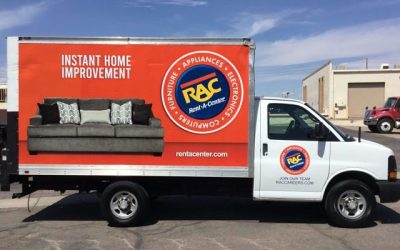
Box truck wrap planning for vehicles with side access doors and loading ramps requires more than fitting graphics onto a large rectangular surface. The design needs to account for moving doors, folding ramps, hinges, handles, hardware, and the way those features change visibility during loading and service.
For businesses in Goodyear, AZ, box trucks are often used for deliveries, moving services, equipment transport, events, and mobile operations. Because these vehicles are opened and closed throughout the day, the graphics should remain clear in both travel mode and working mode.
Why Do Side Access Doors Affect the Wrap Layout?
Side access doors create breaks in what would otherwise be one large uninterrupted panel.
A standard box truck may have a long, flat side that seems ideal for oversized graphics. Once a side door is added, however, that surface is divided by hinges, handles, seams, and moving edges.
Important elements should not depend on the door being closed at all times.
For example, placing the company name across both the fixed wall and the access door may make the logo incomplete when the door is open. The same problem can happen with phone numbers, service descriptions, or website information.
A stronger layout keeps the most important branding within stable visual zones.
Where Should the Main Business Name Be Placed?
The business name or primary logo should usually sit on a large section that stays visible during normal use.
Depending on the truck, that may be:
- The front half of the box
- A large rear-side section
- The cab doors
- The upper portion above a side access door
The exact position depends on the size of the door and how frequently it is opened.
If the side door is used constantly during deliveries, the design should assume that it may stay open for long periods. That means the truck still needs to communicate the company identity without relying on that moving section.
How Should Graphics Work Around Door Hinges and Handles?
Hinges, handles, locks, and latches are small compared with the overall box, but they can interfere with readability if they are ignored.
Text should not run directly beneath a handle. Detailed artwork should not place a face, product, or key image where a hinge interrupts it.
The design can use open space or less critical visual elements around hardware.
Broad color fields, gradients, and background patterns usually work better around these interruptions than small text or fine detail.
For box truck graphics, those practical decisions can make the difference between a design that looks intentional and one that appears awkward once installed.
What Happens When a Loading Ramp Is Deployed?
Loading ramps can change the way the rear and lower side areas of the vehicle are seen.
A fold-out ramp may cover part of the rear bumper area, overlap the lower graphics, or change the viewing angle of the truck during loading. Some box trucks use side ramps, while others rely on rear ramps or hydraulic lift systems.
The wrap should be reviewed with the ramp in use, not only when it is stored.
Important information should remain visible above or beside the ramp whenever possible.
The business should also consider what customers see while employees are unloading. If the rear is open and the ramp is down, branding on the closed door may no longer be visible.
That is another reason the side panels need to carry enough identity on their own.
Should the Ramp Itself Carry Graphics?
That depends on the ramp material, surface, movement, and wear.
Loading ramps are functional equipment. They may be walked on, rolled over by carts, exposed to dirt, and subjected to repeated contact.
Because of that, the wrap design should not assume every ramp surface is appropriate for vinyl.
The graphics provider should evaluate the material and how the ramp is used before deciding whether it should be included.
In many cases, it makes more sense to keep the main branding on the surrounding box panels and treat the ramp as part of the working equipment.
How Can the Side and Rear Graphics Stay Consistent?
The design should use one clear brand system across all visible areas.
That may include:
- Matching logo treatment
- Consistent typography
- Core brand colors
- Similar graphic shapes
- Repeated contact information
- The same service terminology
The side and rear do not need identical layouts.
A large side panel may carry the full logo and service message, while the rear uses a simplified version with the business name, website, and phone number.
The goal is to make the truck recognizable from different directions while working around each surface’s limitations.
Should Service Lists Appear Near the Side Door?
Only if they remain easy to read.
The side access area is often busy. Handles, hinges, door seams, and nearby equipment can make a long service list look crowded.
It may be better to place one short service category near the door and use a cleaner section of the box for additional information.
The largest advantage of custom truck wraps is not the ability to fill every inch. It is the ability to organize information according to how people actually see the vehicle.
How Do Vehicle Wraps for Trucks Support Different Operating Conditions?
A box truck can be viewed in several ways throughout the day:
- Driving through traffic
- Parked at a customer location
- Loading at a warehouse
- Unloading at an event
- Sitting with the rear open
- Sitting with a side door open
A design that only works when the truck is fully closed is not accounting for real-world use.
Businesses researching vehicle wraps for trucks should provide photos showing the vehicle in these different configurations. Fast-Trac Designs creates custom truck wraps and commercial graphics for businesses serving Goodyear and surrounding Arizona communities.
What Should Be Documented Before Production?
Before the graphics are finalized, the business should gather:
- Exact truck year, make, and model
- Box dimensions
- Side door size and location
- Door swing direction
- Handle and hinge placement
- Ramp type and dimensions
- Liftgate or hydraulic equipment
- Existing decals
- Surface condition
- Required safety or regulatory markings
- Current logo and contact information
Photos should show the truck from every side with doors and ramps both closed and open.
This makes it easier to understand what remains visible during normal operation.
How Can Box Truck Graphics Stay Clear During Loading and Service?
The best approach is to design around movement from the beginning.
Side doors and loading ramps should be treated as functional parts of the vehicle, not as surprises that appear after the artwork is finished. Stable surfaces should carry the strongest branding, while moving sections support the design without becoming essential to understanding it.
For Goodyear businesses, that creates a box truck wrap that works while driving, loading, unloading, and serving customers. When the graphics reflect the way the truck is actually used, the finished design is easier to read, more practical, and more consistent throughout the workday.